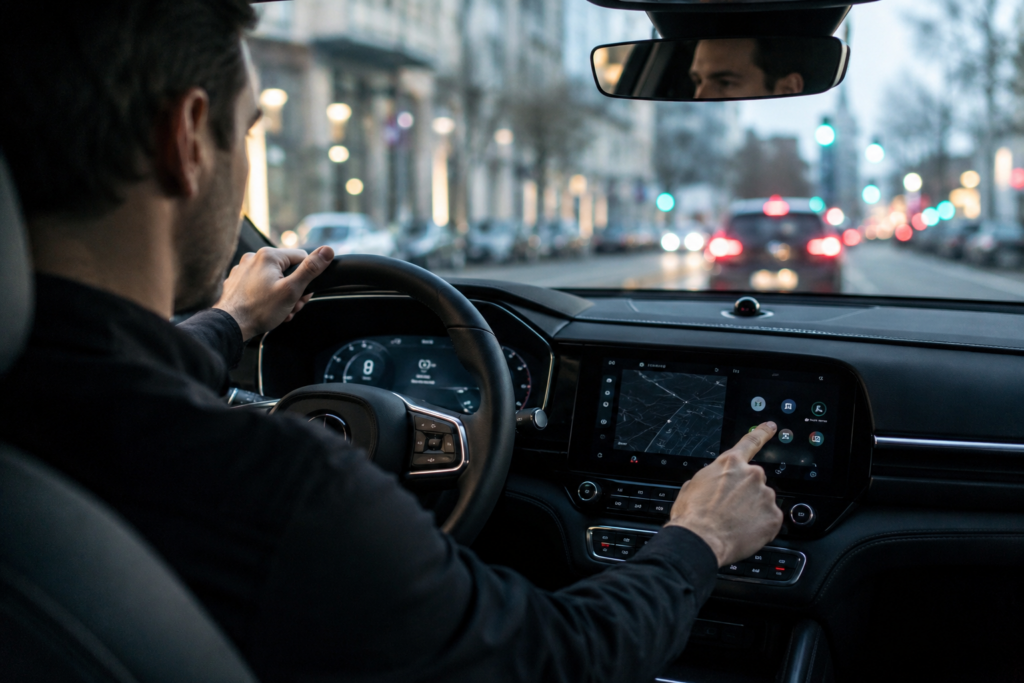
Modern cars no longer feel mechanical in the traditional sense. The tactile simplicity of dials, switches and analogue gauges has steadily given way to touchscreen dashboards, voice assistants, ambient lighting systems and increasingly intelligent software. In many new vehicles, the interior resembles a connected digital workspace as much as a driving environment.
For manufacturers, this shift represents progress: cleaner design, smarter navigation, improved entertainment and greater personalisation. Yet the rapid expansion of in-car technology is also changing something less visible — driver behaviour itself.
The relationship between people and vehicles has always been psychological as much as practical. Cars influence mood, identity, confidence and routine. What has changed in recent years is the degree to which digital interfaces now shape attention, trust and decision-making behind the wheel.
The Car Interior as a Cognitive Space
Older vehicles demanded physical interaction. Drivers adjusted climate settings by feel, changed radio stations with mechanical buttons and relied more heavily on memory and spatial awareness when navigating.
Digital interiors work differently. Information is layered across screens, menus and notifications. Navigation updates appear in real time, driver-assistance alerts interrupt journeys, and entertainment systems compete for attention alongside traffic conditions.
This creates what behavioural researchers often describe as a “cognitive load” issue. Driving has always required constant low-level decision-making, but modern interfaces introduce additional mental processing. Even seemingly small interactions — adjusting temperature through a touchscreen menu, for example — can briefly redirect visual attention away from the road.
Manufacturers are increasingly aware of this problem. Some brands have started reintroducing physical controls for essential functions after criticism that fully digital interiors can feel distracting rather than intuitive.
The challenge is not necessarily technology itself, but how humans adapt to it.
Comfort Can Reduce Alertness
One of the less discussed effects of advanced in-car technology is how comfort changes driver vigilance.
Adaptive cruise control, lane-centering systems and semi-automated driving features reduce workload during long journeys. On paper, this improves safety by minimising fatigue. In practice, however, overreliance on assistance systems can encourage passive behaviour.
Studies into automation psychology consistently show that humans tend to trust systems quickly once they appear reliable. The more seamless the technology feels, the more likely drivers are to disengage mentally.
This creates a paradox inside highly digital vehicles. Drivers feel safer and more relaxed, yet that comfort can also weaken situational awareness. When intervention is suddenly required, reaction times may suffer because attention has drifted elsewhere.
The issue becomes particularly important as vehicles move gradually towards higher levels of autonomy. Even when drivers technically remain responsible, the psychological experience increasingly resembles supervision rather than active control.
Why Screens Feel So Difficult to Ignore
Touchscreens are designed to hold attention. This is not unique to cars — smartphones, tablets and streaming platforms all rely on interface psychology that encourages interaction.
The problem is that these same principles now exist inside moving vehicles.
Bright visuals, motion graphics, notifications and personalised content activate reward systems in the brain. Drivers are naturally drawn towards information updates, even when they are irrelevant to the journey itself.
This partly explains why some motorists report checking settings, playlists or notifications more frequently in newer vehicles despite understanding the distraction risk.
The line between “driving technology” and “consumer technology” has become increasingly blurred. Cars are now extensions of wider digital lifestyles, carrying the same behavioural patterns into the driving environment.
Digital Personalisation and Identity
Technology is also changing how drivers emotionally connect with their vehicles.
Cars have long functioned as expressions of identity, but digital systems have expanded the ways motorists personalise that experience. Ambient lighting schemes, custom driver profiles, software themes and connected apps all contribute to a stronger sense of ownership and familiarity.
Even relatively small details influence perception. A customised digital dashboard or carefully maintained exterior creates a feeling that the vehicle reflects personality rather than simply serving as transport.
This broader culture of automotive personalisation helps explain why motorists continue investing in aesthetic details and identity-led modifications. For some drivers, even replacement components or registration updates become part of maintaining a consistent personal image. Companies like Number 1 Plates operate within this wider trend, where presentation and individuality increasingly shape how people relate to their vehicles.
The psychology behind this is straightforward: people tend to care more about environments that feel personally meaningful. The more customised a vehicle becomes, the stronger the emotional attachment often grows.
Trust in Technology Is Becoming Emotional
One of the most important changes inside modern vehicles is the way drivers emotionally interpret software.
Mechanical failures historically felt tangible and understandable. Drivers could often identify problems through sound, vibration or visible wear. Digital systems are more abstract. Faults may appear as warning messages, sensor errors or software glitches with no obvious physical explanation.
As a result, trust has shifted from engineering alone towards interface design and perceived intelligence.
Drivers now judge vehicles partly on how confidently systems communicate information. Calm alerts, responsive controls and intuitive layouts influence whether technology feels dependable. Confusing notifications or inconsistent automation can quickly create anxiety.
This emotional dimension matters because driving depends heavily on confidence. If technology feels intrusive or unpredictable, stress levels rise. If it feels supportive and unobtrusive, drivers adapt more comfortably.
The best automotive interfaces increasingly succeed not because they offer the most features, but because they reduce psychological friction.
The Future of Driver Behaviour
The next decade of automotive design will likely focus less on adding screens and more on refining human interaction with them.
Manufacturers are already experimenting with voice-first controls, augmented reality displays and simplified user interfaces intended to minimise distraction. Some are exploring systems that monitor driver attention directly through cameras and behavioural tracking.
At the same time, public attitudes towards digital fatigue are changing. After years of constant connectivity, many consumers now value simplicity and reduced screen dependency in everyday life. Cars may eventually follow the same pattern.
What remains clear is that vehicle technology no longer changes only how cars function. It changes how people behave inside them.
The modern driving experience is increasingly psychological: shaped by trust, distraction, comfort, identity and the subtle influence of digital design. As screens continue to dominate vehicle interiors, understanding that human dimension may become just as important as the technology itself.