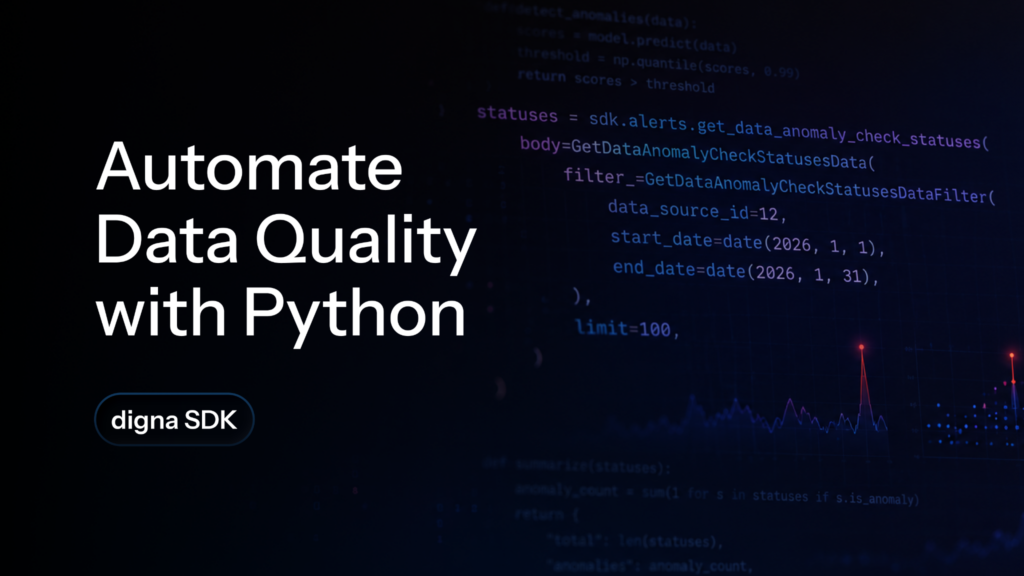
The market for Data Observability and Data Quality platforms has evolved significantly over the last few years. Organizations are no longer looking only for dashboards that display alerts and data quality metrics. They increasingly expect tools that can be integrated directly into engineering workflows, automated processes, and modern data platforms. Against this backdrop, the digna Python SDK Release represents an important step in the evolution of the Digna platform.
- How is the Data Observability market evolving?
- Why is Python such an important part of this shift?
- What does the digna Python SDK Release introduce?
- Why does this matter for DataOps teams?
- How does Digna compare to other platforms?
- Why are developer-focused features becoming essential?
- What does this mean for the future?
The move also places Digna alongside vendors such as Monte Carlo, Bigeye, and Soda, which have invested heavily in developer-oriented tooling and programmatic access to their platforms.
How is the Data Observability market evolving?
The first generation of observability platforms focused primarily on monitoring data quality, detecting anomalies, and notifying users when problems occurred. As data ecosystems became larger and more complex, organizations began demanding deeper integration with their existing technical environments.
Today, many data teams want to:
- automate monitoring processes,
- manage configurations through code,
- integrate validation into data pipelines,
- build custom workflows,
- reduce manual operational work.
As a result, SDKs and APIs have become increasingly important components of modern observability platforms.
Why is Python such an important part of this shift?
Python remains one of the most widely used languages in data engineering, analytics, machine learning, and AI development. Many organizations already rely on Python-based workflows to build, test, deploy, and monitor data systems.
For this reason, a Python SDK offers significant advantages. Instead of performing every task through a graphical interface, teams can interact with platform capabilities directly from their existing development environments.
Typical use cases include:
- automating monitoring setup,
- integrating checks into CI/CD pipelines,
- managing observability through code,
- creating custom automation scripts,
- building reusable governance workflows.
This approach aligns closely with modern infrastructure-as-code and DataOps practices.
What does the digna Python SDK Release introduce?
The digna Python SDK Release expands platform accessibility by providing a programmatic layer that allows developers and data engineers to interact with Digna directly from Python environments.
Rather than relying exclusively on dashboards and manual configuration, teams can incorporate observability and data quality functions into automated workflows. This reflects a broader industry trend toward treating data monitoring as an integrated component of engineering operations rather than a separate administrative task.
The release demonstrates how observability platforms are increasingly moving toward developer-first architectures.
Why does this matter for DataOps teams?
Modern organizations often operate dozens or even hundreds of data pipelines. Managing monitoring and validation manually across such environments can quickly become inefficient.
Programmatic access helps teams:
- deploy monitoring faster,
- standardize implementations,
- reduce configuration errors,
- automate quality checks,
- scale operations more effectively.
For DataOps teams, this means observability can be managed similarly to other infrastructure components, using familiar engineering tools and processes.
How does Digna compare to other platforms?
Companies such as Monte Carlo, Bigeye, and Soda helped establish many of the practices now associated with modern Data Observability. Their platforms demonstrated the value of automated monitoring, anomaly detection, and developer-focused workflows.
The digna Python SDK Release signals that Digna is following a similar direction. Rather than focusing solely on visual monitoring interfaces, the platform is expanding its capabilities to support automation and integration within broader engineering ecosystems.
This reflects a growing expectation across the industry that observability platforms should function as programmable systems rather than standalone monitoring tools.
Why are developer-focused features becoming essential?
Data environments continue to increase in complexity. Organizations need solutions that can scale with growing volumes of data, larger teams, and more sophisticated workflows.
Developer-oriented features provide several benefits:
- greater flexibility,
- improved automation,
- easier integration,
- faster deployment,
- more consistent governance practices.
As a result, SDKs are becoming a standard feature rather than a differentiator in the observability market.
What does this mean for the future?
The introduction of the digna Python SDK Release highlights a broader shift taking place across Data Quality and Data Observability platforms. Organizations increasingly expect monitoring, validation, and governance tools to integrate directly into engineering workflows rather than operate as isolated systems.
As data infrastructure becomes more automated and AI-driven, platforms that support programmatic interaction are likely to play a larger role in enterprise environments. The addition of a Python SDK positions Digna within this ongoing evolution and reflects the growing importance of developer-centric observability solutions across the industry.