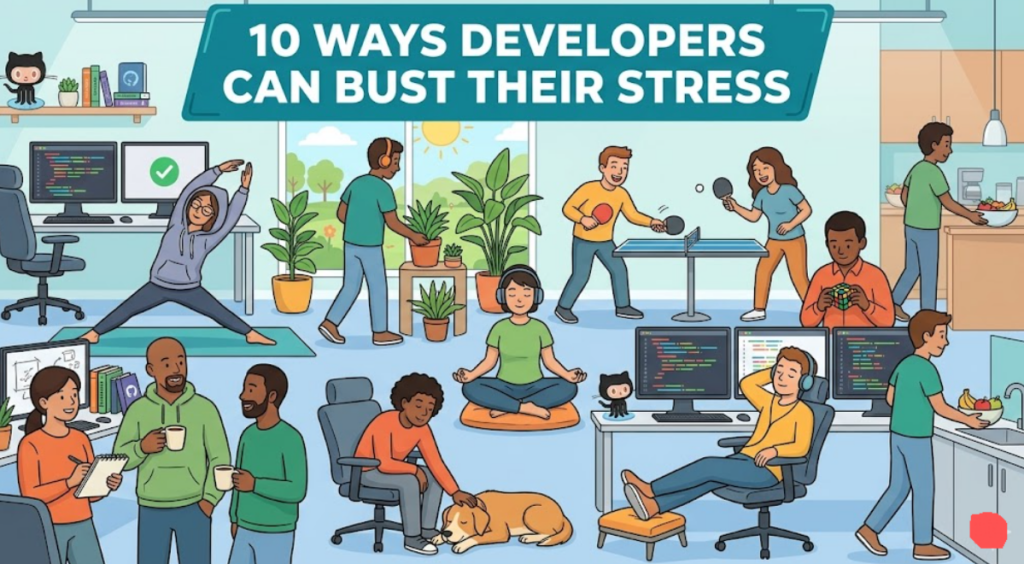
Developer stress is a documented occupational health problem. A 2023 Stack Overflow survey of over 90,000 developers found that 62% reported feeling burned out in the previous year, with workload and unclear requirements listed as the top causes. That figure is not an anomaly. It reflects a structural reality of the industry.
The ten strategies below address that reality directly. Some are behavioural. Some are physical. One is a supplement worth knowing about. All of them work, and each takes less effort to start than most developers assume.
1. Try CBD Oil
CBD (cannabidiol) oil is legal in the UK as a food supplement when it meets FSA novel food authorisation requirements. The Food Standards Agency sets a daily consumption guidance of 10mg for healthy adults. Within that guidance, a growing number of developers are using CBD as part of a daily stress management routine.
CBD interacts with the endocannabinoid system, which regulates mood, sleep, and the stress response. It does not produce a psychoactive effect. Research published in The Permanente Journal found that 79.2% of participants reported lower anxiety scores within the first month of CBD use, with sleep also improving in the majority of cases.
“The endocannabinoid system is one of the most important physiological systems involved in establishing and maintaining human health. Endocannabinoids and their receptors are found throughout the body.”
Dr. Dustin Sulak, integrative medicine physician and founder of Healer.com
For developers, CBD oil fits practically into a working day. A few drops of full spectrum cbd oil in the morning, or during a particularly difficult sprint, does not impair cognitive function or reaction time. Look for products with batch-specific certificates of analysis covering cannabinoids, THC levels, pesticides, heavy metals, and microbiological safety. The legal THC limit for finished CBD products in the UK is 1mg per container.

CBD does not treat stress. It does not cure anxiety. What it does for many users is reduce the physical baseline of tension enough to make the other strategies on this list easier to execute.
2. Use the Pomodoro Technique
Francesco Cirillo developed the Pomodoro Technique in the late 1980s as a university student struggling with distraction. The method is simple: 25 minutes of focused work, then a 5-minute break, repeated four times before a longer rest. Decades of productivity research support the underlying principle. The brain fatigues under sustained cognitive load, and short recovery intervals restore attention more effectively than pushing through.
For developers, the method also addresses a subtler problem: the paralysis that comes from staring at a complex task with no defined entry point. A 25-minute window forces a start. That is often the hardest part.
3. Set Hard Boundaries on Working Hours
Remote work has dissolved the physical signal that used to end the working day. When the office is your bedroom, there is no commute to mark the transition. Research from Microsoft’s 2022 Work Trend Index found that after-hours Teams activity increased by 28% globally between 2020 and 2022, with developers among the most affected groups.
“Always-on work culture is one of the most significant contributors to developer burnout. The expectation of constant availability erodes recovery time, and without recovery, performance degrades.”
Dr. Christina Maslach, professor emerita of psychology at UC Berkeley and co-creator of the Maslach Burnout Inventory
Set a hard end time. Communicate it to your team. When the day ends, close the machine. The inbox will wait. Your nervous system will not.
4. Exercise, Even Briefly
A 2018 meta-analysis published in JAMA Psychiatry, covering data from over 1.2 million Americans, found that people who exercised reported 43.2% fewer days of poor mental health per month than those who did not. The effect held for walks, yoga, and cycling, not just high-intensity training.
Twenty minutes of movement during your lunch break is enough to shift cortisol levels measurably. The barrier is not time. It is the inertia of sitting in a chair. Stand up before you debate whether to go.
5. Meditate for Five Minutes
A 2011 study from Massachusetts General Hospital found that eight weeks of mindfulness meditation produced measurable changes in the grey matter density of the amygdala, the brain region most associated with stress and anxiety. You do not need eight weeks to feel a difference. Five minutes of breath-focused attention each morning lowers the reactivity you carry into the rest of the day.
Apps like Headspace and Insight Timer give you a structure to follow. Neither costs much. The return per minute is among the highest of anything on this list.
6. Learn to Push Back on Scope
Most developer stress is not caused by hard problems. It is caused by vague requirements, moving goalposts, and deadlines set by people who do not write code. The fix is not resignation. It is structured pushback.
When a new task arrives mid-sprint, respond with context rather than compliance: what it displaces, what the tradeoff is, what the realistic timeline looks like. Managers who understand this respond well. Managers who do not are the source of the problem, not the solution.
7. Build a Peer Network
Loneliness is a physiological stressor, not a personal failing. A 2023 report from the UK’s Office for National Statistics found that people who reported strong workplace social connections were 38% less likely to experience high-level stress symptoms. For remote developers, that connection rarely happens by accident.
Join a developer Discord. Attend a local meetup. Find one person at work you speak to off-Slack. Talking to someone who understands why a merge conflict at 4pm on a Friday is genuinely dreadful is more therapeutic than most people admit.
8. Protect Your Sleep
Matthew Walker, professor of neuroscience at UC Berkeley and author of Why We Sleep, has described sleep deprivation as one of the most damaging health choices a person makes repeatedly without realising the consequences.
“The shorter your sleep, the shorter your life. The physical and mental impairments caused by one night of bad sleep dwarf those caused by an equivalent absence of food or exercise.”
Matthew Walker, neuroscientist, UC Berkeley
Developers who consistently sleep under six hours report higher error rates, slower debugging, and lower tolerance for ambiguity. Aim for seven to nine hours. Set a consistent wake time. Reduce screen brightness an hour before bed. These are not suggestions. They are the conditions under which your brain works properly.
9. Organise Your Digital Environment
Cognitive load is cumulative. Every browser tab open in the background, every unmuted Slack channel, every unread notification adds a small tax on working memory. Researchers at Princeton University found in a 2011 study that physical and digital clutter directly competes with the brain’s capacity to focus and process information.
Audit your tools once a week. Close what you do not need. File what you have finished. A clean workspace does not make you a better coder, but it removes the friction that makes hard problems feel harder.
10. Record What You Finish
Developers are trained to see gaps. Code review is a hunt for faults. Retrospectives often focus on what went wrong. This occupational bias toward finding problems means that progress routinely goes unregistered.
Keep a running log of completed tasks alongside your to-do list. At the end of each week, read it back. The list of things you shipped, fixed, and delivered is almost always longer than the one you carried in your head. Momentum is a real psychological resource, and acknowledging it costs nothing.
The Takeaway
Sixty-two percent of developers burned out last year. The industry normalises that number instead of treating it as the problem it is. Start with sleep and boundaries. Add movement and five minutes of meditation. If you want a natural supplement to sit alongside those habits, CBD oil at FSA-recommended doses is worth a considered try. You do not need all ten at once. You need two or three done consistently. That is where the difference starts.