
Why the software embedded in a device determines its success far more than the silicon beneath it
Pick up any successful connected device — a medical wearable that detects arrhythmias, an industrial sensor that predicts equipment failure, a smart thermostat that learns occupancy patterns — and you will find that its hardware specification is rarely what earns it a place in the market. The processor, memory, and radio module are commodities. What is not a commodity is the layer of intelligence woven into them: the firmware. Professional firmware development is what makes a device truly “smart” — converting raw electrical signals into meaningful decisions, unreliable components into dependable products, and anonymous hardware into a competitive market position. In the modern product landscape, the intelligence inside a device is the product.
Hardware as a Commodity, Software as a Differentiator
The economics of hardware have changed dramatically over the past two decades. Reference designs, contract manufacturers, and off-the-shelf modules have dramatically compressed the time and capital required to bring physical electronics to market. A startup today can source a capable microcontroller, a connectivity module, and a power management IC and have a functional prototype within weeks. The hardware itself is no longer a moat.
What separates a product that defines a category from one that fails to find buyers is almost always the behavior of the device — its responsiveness, its reliability under real-world conditions, its energy efficiency, its ability to update and improve over time. All of these qualities live in firmware. This inversion — where the physical artifact is secondary to its embedded software — has profound implications for how product companies think about engineering investment, team structure, and competitive strategy.
Where Hardware Ends, and Intelligence Begins
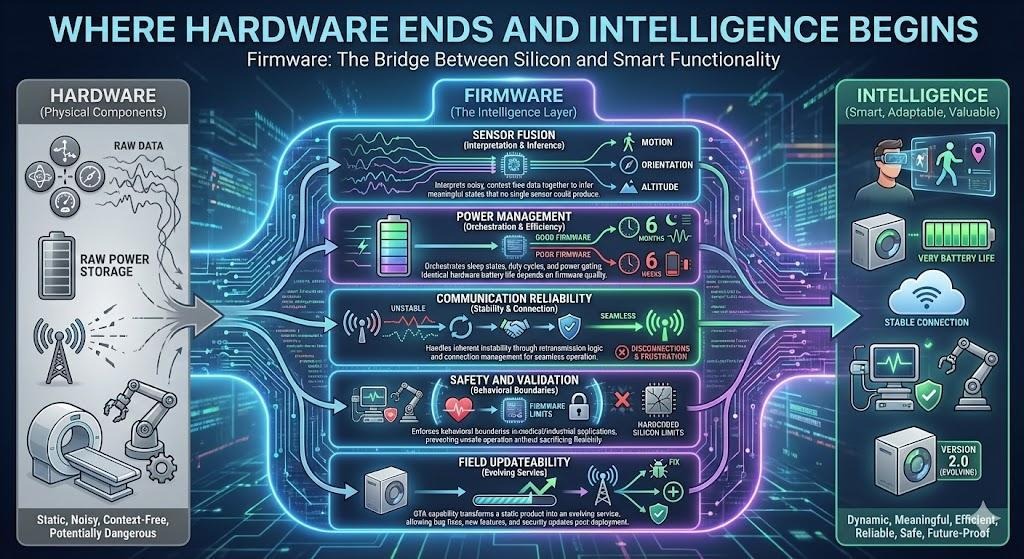
- Sensor fusion: Raw sensor data is noisy and context-free. Firmware algorithms interpret accelerometer, gyroscope, and barometric data together to infer meaningful states — motion, orientation, altitude — that no single sensor could produce alone.
- Power management: A battery-powered device lives or dies by its firmware’s ability to orchestrate sleep states, duty cycles, and peripheral power gating. Identical hardware can deliver either 6 months or 6 weeks of battery life depending entirely on firmware quality.
- Communication reliability: Wireless protocols are inherently unstable. The retransmission logic, connection management, and error recovery embedded in firmware determines whether a device operates seamlessly or frustrates users with disconnections.
- Safety and validation: In medical and industrial applications, firmware enforces the behavioral boundaries that prevent a device from operating outside safe parameters — limits that cannot be hardcoded into silicon without sacrificing flexibility.
- Field updateability: Over-the-air (OTA) firmware update capability transforms a static physical product into an evolving service, allowing manufacturers to fix bugs, add features, and respond to security vulnerabilities post-deployment.
The Firmware Quality Gap in Commercial Products
Despite firmware’s decisive role in product success, it remains chronically underinvested in many hardware product organizations. The reasons are structural: hardware timelines are visible and milestone-driven, while firmware quality is largely invisible until it fails in the field. A circuit board either arrives or it does not; firmware debt accumulates silently until it manifests as reliability issues, security vulnerabilities, or the inability to scale production.
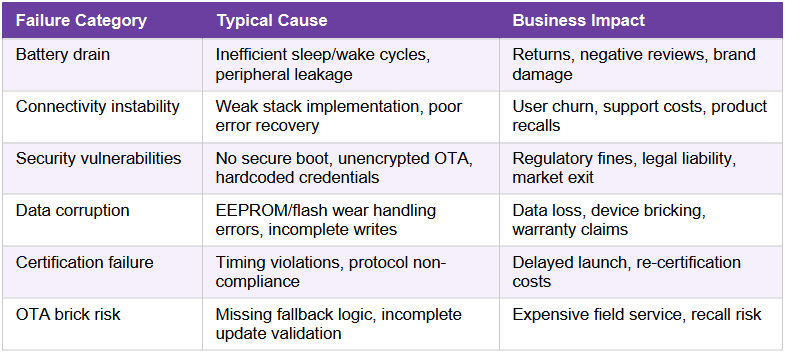
The consequences of poor firmware are not merely technical. They are commercial. A device that drains its battery in three days instead of three weeks earns one-star reviews that persist for the product’s lifetime. A connected product that cannot receive security patches becomes a liability rather than an asset once vulnerabilities are discovered. A medical device with intermittent sensor dropout failures may trigger regulatory action. In each case, the hardware was fine — the intelligence inside it was not.
The Most Costly Firmware Failures
What Professional Firmware Development Actually Means
Professional firmware development is what makes a device smart — not in the marketing sense of the word, but in the engineering sense. It is the discipline of writing software that operates under the most demanding constraints in software engineering: limited RAM measured in kilobytes, processors running at tens of megahertz, real-time response requirements, and the near-impossibility of patching deployed code in physically inaccessible locations.
Meeting these constraints reliably requires a fundamentally different engineering culture than application or web development. Firmware engineers must reason simultaneously about timing, memory layout, interrupt latency, power states, hardware errata, and the failure modes of physical components. The code they write must behave correctly not on a developer’s machine but in a plastic enclosure, exposed to temperature swings, vibration, electromagnetic interference, and the unpredictable behavior of real-world networks.
The Core Disciplines of High-Quality Firmware
- RTOS architecture: Choosing and correctly implementing a real-time operating system — whether FreeRTOS, Zephyr, or a bare-metal scheduler — establishes the task model that determines responsiveness, power behavior, and concurrency safety across all device functions.
- Hardware abstraction: A well-designed hardware abstraction layer (HAL) separates business logic from register-level driver code, enabling testing, portability, and maintainability across silicon revisions.
- Bootloader and secure boot: A robust bootloader with cryptographic verification of firmware images is the foundation of both update reliability and device security, preventing unauthorized code execution from the moment power is applied.
- Memory safety: Stack overflow detection, heap fragmentation management, and disciplined use of static allocation prevent the class of memory errors that cause intermittent, nearly-impossible-to-reproduce field failures.
- Protocol stack implementation: Whether implementing BLE, Wi-Fi, CAN, Modbus, or proprietary RF protocols, the quality of the protocol stack implementation directly determines communication reliability under real-world RF conditions.
- Test infrastructure: Unit testing on host, hardware-in-the-loop simulation, and automated regression suites are not luxuries in firmware development — they are the only realistic defense against regressions in systems where manual testing cannot cover the combinatorial space of hardware states.
Firmware as a Product Lifecycle Strategy
The most forward-thinking hardware manufacturers have begun treating firmware not as a launch deliverable but as a continuous product. This shift mirrors the transition from packaged software to software-as-a-service, applied to physical devices. A product shipped with OTA update capability, a remote diagnostics pipeline, and a structured versioning and release process is not just a device — it is a platform.
How Firmware Strategy Extends Product Value
- Post-launch feature delivery: Features held back due to hardware certification timelines or market testing can be enabled via OTA updates after launch, extending the commercial relevance of a hardware SKU.
- Predictive maintenance enablement: Firmware that logs internal state, sensor anomalies, and error counters can feed cloud analytics pipelines that predict component failure before it occurs — transforming a reactive support model into a proactive service.
- Regulatory compliance updates: Medical devices, industrial controllers, and communications products operate under regulations that evolve. Firmware updateability allows a deployed device fleet to maintain compliance without physical hardware replacement.
- Security patching at scale: The average connected device remains in service for five to ten years. A disciplined OTA infrastructure allows manufacturers to respond to newly discovered vulnerabilities across an entire installed base within days rather than years.
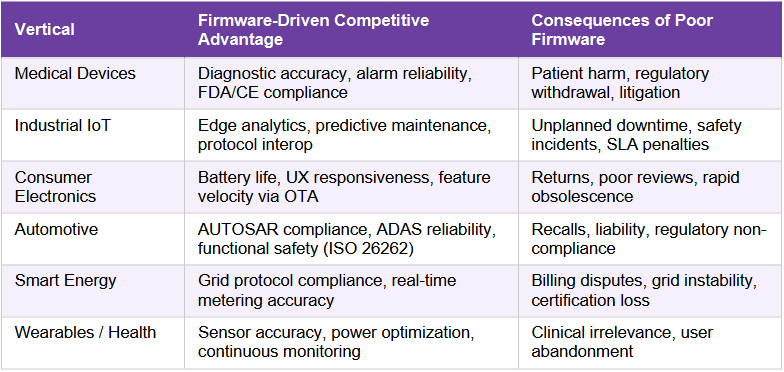
Industry Verticals Where Firmware Is the Product
The centrality of firmware quality is not uniform across industries — it is most starkly visible in verticals where device behavior has direct consequences for safety, regulatory compliance, or the economics of scale.
Building the Right Team: Internal vs. External Expertise
For most hardware product companies, the decision of whether to build firmware capability internally or partner with specialist firms is one of the most consequential early choices they make. Internal teams offer deep product context and long-term institutional knowledge. External specialists bring cross-industry pattern recognition, established toolchains, and the ability to staff up rapidly without the lead time of senior embedded hiring.
The most effective model is usually a hybrid: a small internal firmware owner who maintains architectural authority and product context, working alongside an experienced external partner for implementation depth and delivery capacity. Companies like Yalantis, which develops custom firmware solutions across embedded platforms ranging from microcontrollers to application processors, exemplify the kind of specialist partner that allows hardware product teams to reach production-grade firmware quality without building an entire embedded engineering organization from scratch.
Evaluating Firmware Development Partners
- RTOS and protocol breadth: A credible partner should have demonstrated experience across multiple real-time operating systems and communication stacks — not just one familiar configuration.
- Security practice: Ask specifically about secure boot implementation, encrypted OTA pipelines, and cryptographic key management. These are table-stakes for any connected product shipping in 2025.
- Testing infrastructure: Mature firmware teams test on host as well as hardware, with automated pipelines covering both unit and integration scenarios. Ad-hoc manual testing is a warning sign.
- Certification experience: If your product requires FCC, CE, FDA, IEC, or AUTOSAR certification, verify that the partner has navigated those processes before — ideally in your specific vertical.
- OTA track record: Review whether the partner has shipped and maintained OTA update systems in production environments, not just designed them in architecture documents.
Conclusion
The physical form of a product is what customers hold in their hands. The firmware is what they actually experience. It determines whether their device responds instantly or hesitates, whether it lasts a full day or dies before evening, whether it remains secure two years after purchase or becomes a vulnerability on their network. It determines whether a medical device earns clinical trust or fails regulatory scrutiny. It determines whether an industrial sensor delivers ROI or generates maintenance tickets.
As hardware commoditization continues and product differentiation shifts decisively toward software, the companies that treat firmware as a strategic engineering investment — rather than a launch checklist item — will be the ones that build durable market positions. The intelligence inside a device is not a feature. It is the product. And building it well, from architecture to OTA infrastructure, is what separates hardware that wins in the market from hardware that merely ships.